
 Empower Rise Digital India – Introduction
The goal of the current digital revolution is to improve future conditions. It’s possible for this shift to have far-reaching consequences for people everywhere, including in terms of society, the economy, and the world as a whole. Not only that, but digitization has revolutionized the way data is shared throughout diverse sectors of the globe. Creating opportunities for companies to expand outside domestic markets, driving growth in international trade, and strengthening global ties.
One of the hallmarks of these altering trends is the digital revolution in India which has been grabbing a grasp since smartphones and 4G broadcasting have grown widespread outside urban areas including many remote regions too. In 2019, India has more than 550 million internet subscribers and over 200 million smartphone users. Significant rural-to-urban migrations, in which impoverished farmers move to India’s metropolitan centers in search of economic opportunity, have greatly accelerated this shift. The Indian government has been actively pursuing digitization through a number of different channels since 2014. One such event is demonetization, which has received widespread media coverage but has also been linked to temporary drops in employment and economic activity. But it also demonstrates government leadership’s compliance to push the digital revolution in India.
 Digital Initiatives Started By Goal
India has taken genuine steps toward becoming a vital economic engine of the globe, and now the country stands on the brink of a game-changing chance to assume global leadership. A digital revolution is underway in the country, leading to revolutionary changes in many fields. So, let’s talk over everything that’s changed between 2014 and 2022.
 Trends In The Market
The government’s agenda is not the sole factor propelling India’s digital revolution. The concept revolves around a shift in the sophistication and utility of the average customer. YouTube’s largest country-specific audience is now located in India. In addition, Indians consume on average of 8.48 terabytes each month through their smartphone users’ voracious streaming habits. Streaming in India is expected to expand the country’s industry in several ways. It has been speculated that global giants like Google, Facebook, Amazon, and Netflix are vying for positions in this new market.
 Online Employment
The following is information that some people may not know. The Indian government’s endeavor is really impressive. According to the Online Labour Index (OLI), India accounts for 24% of the online labor share of the market (as of 2017), creating opportunities for software engineers, data input operators, online salespeople, and creative professionals.
 E-Commerce
As the e-commerce industry grows and develops new services from the perspective of suppliers, more and more opportunities arise in the logistics sector. The online retail industry is predicted to grow between INR 2,484.9 billion in 2017 to INR 8,526.5 billion in 2020, a CAGR of 51%. Employment opportunities in warehouse management, content creation, and marketing are also possible outcomes.
 Model for Aggregation
To manage India’s vast blue-collar workforce, online marketplaces have emerged. New employment opportunities have arisen in India as a result of the proliferation of innovation aggregator business rules in fields including taxi cabs, food delivery, hotel reservations, and home service specialists.
 Start-Ups In Technology
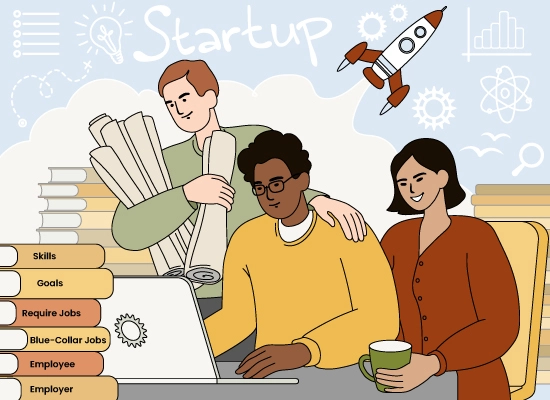
Many new businesses have emerged in response to the rise of the internet, creating new opportunities for people to find gainful employment. New employment in Big Data, statistics, and cloud computing are needed due to the 12-15% increase in the number of digital start-ups in India between 2014 and 2019. Information security, social media services, and development of mobile apps are just a few of the fields that have seen a rise in employment.
The administration under Prime Minister Modi has recognized the great promise of startups in transforming the economy and releasing technology-driven transformation. The government should look at other ideas to encourage startups in India to take part in the country’s digital transition, in addition to enacting existing policies that are helpful to this end. There are currently around 21,000 startups in India, with roughly 9,000 focusing on technology. Many of these items have astronomical prices, with some topping a billion dollars. Visit Facebok






Leave a reply