
Will AI Conquer the Modern Workforce?
A question we all came to ponder over considering how the internet is saturated with our renowned celebrity, ChatGPT. Will ChatGPT take my job? To address the elephant in the room, the answer is No.
Automation is inevitable and is rapidly taking over the entire job market, white-collar and blue-collar alike. However, the possibility of a robot replacing your plumber, or your maid anytime soon is low- and also not economically possible. We’ve reached an innovative curve in the history of mankind. And while a lot of jobs are seemingly endangered, they still cannot be eliminated just yet.
Brilliant research published by the MIT Task Force on the Work of the Future, named “Artificial Intelligence And The Future of Work,” has a rationally optimistic outlook on this development, quoting: “For the foreseeable future, therefore, the most promising uses of AI will not involve computers replacing people, but rather, people and computers working together—as “superminds”—to do both cognitive and physical tasks that could not be done before.”
There’s a lot of ongoing debate and fearmongering about “will AI replace humans”. Or on the extreme end, AI will take over the world, but the fact remains that machines will still lack the human touch of the service industry or any creativity at all. We’ve observed in the past decade a rise in automation which has introduced us to a wide world of technology. Let’s explore some reasons AI won’t overtake human jobs:
AI Lacks Creativity
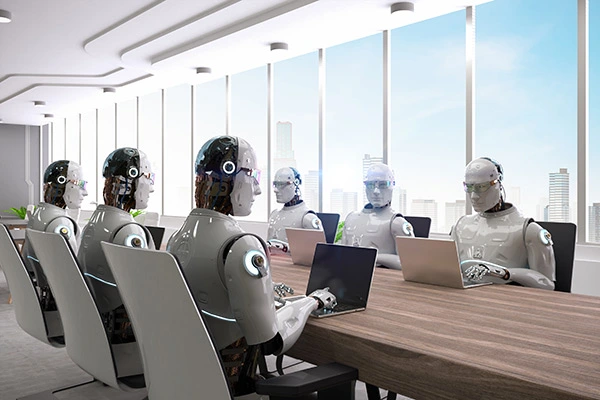 AI is constrained and guided by the data it has been taught, whereas humans can adapt to new circumstances and environments. This basic trait creates a gap between human consciousness and AI, as human workers are frequently better able to navigate and react to new challenges in industries that undergo rapid change, such as pharma, education, and technology. A study conducted by Harvard Business School observes, and we quote: “As the work is repetitive and subject to rigid procedures optimizing efficiency and productivity, AI is able to perform in more accurate ways to human supervisors.
Human abilities, however, are more expansive. Contrary to AI abilities that are only responsive to the data available, humans have the ability to imagine, anticipate, feel, and judge changing situations, which allows them to shift from short-term to long-term concerns. These abilities are unique to humans and do not require a steady flow of externally provided data to work as is the case with artificial intelligence.”
One distinctive quality that makes people forever important in the workplace is emotional intelligence. It is impossible to overstate the value of emotional intelligence in the workplace, particularly when working with customers.
Humans are Intuitively Driven and Empathy Focused – AI is not 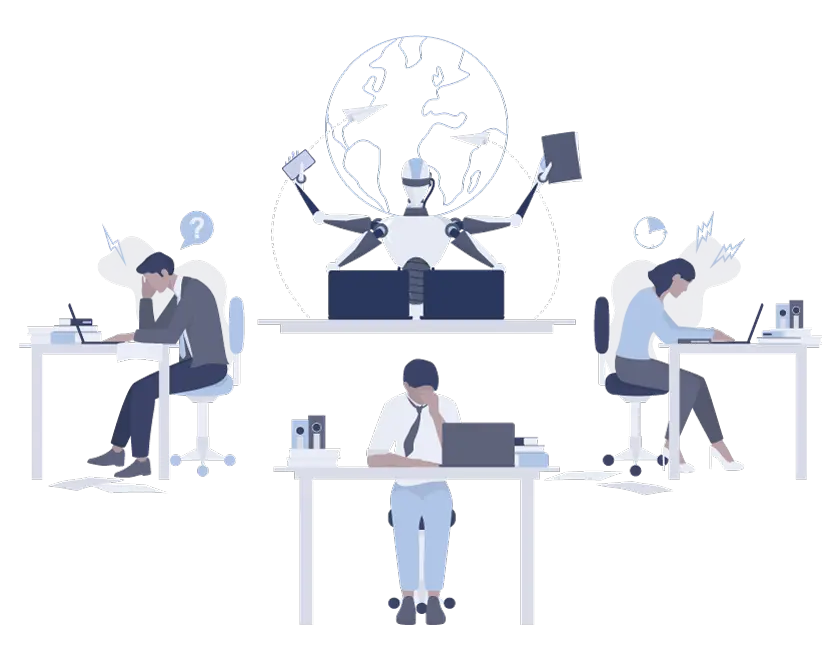
Humans are social creatures, and one fundamental, undeniable need that they have is to feel emotionally connected to other people. While artificial intelligence (AI) attempts to mimic human intelligence, emotional intelligence is more difficult to mimic than intellectual intelligence.
Why you may wonder? Easy, since AI is incapable of feeling the complexities of human consciousness and accompanies emotions such as pain, grief, etc, it needs empathy and a profound understanding of the human condition, particularly pain, and suffering. Wise company leaders and business owners are aware of the value of appealing to the feelings of their staff and customers. Such levels of human connection are impossible for machines to accomplish, but there are ways to develop your emotional intelligence as a human.
It is unlikely that humans will ever form such a strong emotional bond with AI machines, regardless of how well they are designed to react to humans. Even in instances, where AI assists elderly care, and facilitates AI cannot thus replace people, particularly since interacting with others is essential for the expansion of businesses.
AI is your friend – Not a threat
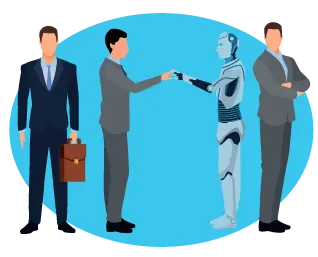 The age of artificial intelligence has already dawned and we stand at the cusp of the fourth industrial revolution. Instead of worrying about jobs at risk of being replaced by AI, seek to recalibrate the situation by understanding how your job can positively integrate with the change. A study has shown that 60% of the working population have started making AI their ally and working hand in hand to make their process easier.
Presently, AI demands total “learning” based on human inputs and is not fully trained with accuracy. The decision-making and the answers are a repetitive script and AI is not up to par with making judgments from a human perspective. It is easily programmable but lacks the key skill of discernment. Will Human Workers Disappear? Not anytime soon and the debate lacks the primitive observation that Artificial Intelligence and humans are starkly different in their mechanics.
Machines will not make humans obsolete, rather they will add a new set of skills under our turf and drastically increase efficiency on all scales.
Final Thoughts
Humans run on instinctual judgments and have displayed qualities of empathetic decision-making, creative thinking, and harmonious cooperation, which are hard to emulate by technology. While we agree that technological rebirth is coming and some jobs may become obsolete. By adapting to the upcoming change, we can ride this wave.
Share your thoughts below!


Leave a reply